
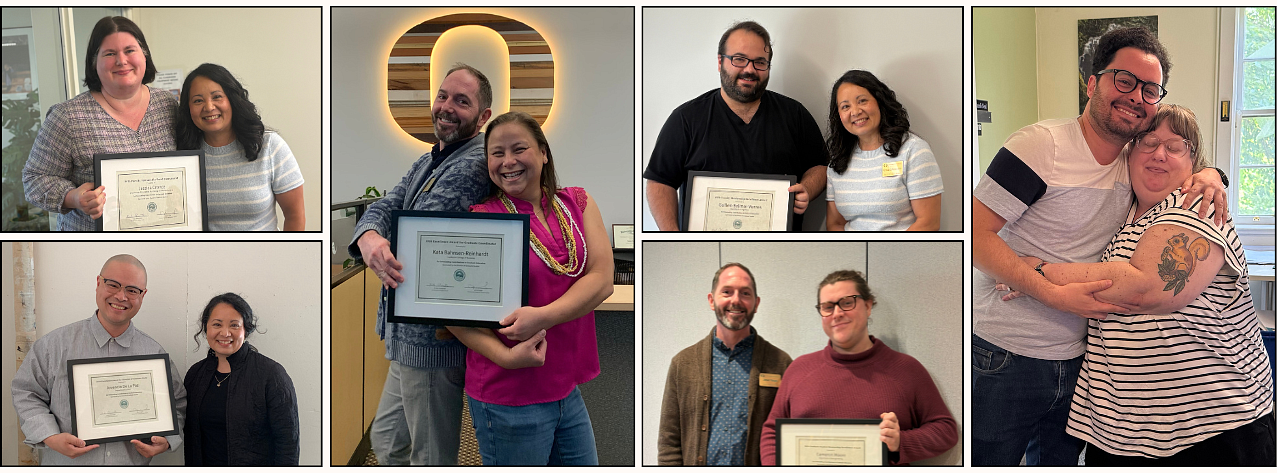
Clockwise from top left: Jessica Cronce, Kata Bahnsen-Reinhardt, Guillem Belmar-Viernes, Emily Ellis, Cameron Moore, and Jovencio De La Paz.
Published June 29, 2026
Graduate education is a transformative experience, shaped by research and coursework, possible, in part, because of the people who guide students as they find their footing and build confidence. The Graduate Education Excellence Awards recognize the faculty, graduate students, and staff whose work helps graduate students flourish at the University of Oregon.
Mentorship that recognizes the whole student
Strong mentorship helps graduate students develop as scholars while honoring the unique experiences, identities, and goals they bring to their work. Mentors help students identify their strengths, navigate challenges, and imagine new possibilities. Guillem Belmar-Viernes and Jessica Cronce, winners of the Excellence in Mentorship Award for Faculty Mentors, provide mentorship that recognizes the whole student.
Belmar-Viernes is an assistant professor in linguistics whose research focuses on understanding linguistic minoritization and how communities maintain or revitalize their languages.
One nominator connected this research to Belmar-Viernes' mentorship style. "His work on language revitalization, minoritized languages, and language rights reveals a strong dedication to honoring communities and identities. As a mentor, he seeks to empower students to appreciate their experiences, develop confidence, and view their expertise as valuable in academic contexts."
Other nominators echoed this sentiment, highlighting Professor Belmar-Viernes' "deep understanding of the challenges faced by international graduate students."
As a mentor, [Dr. Belmar-Viernes] seeks to empower students to appreciate their experiences, develop confidence, and view their expertise as valuable in academic contexts.
Cronce is an associate professor in counseling psychology whose research and clinical interests focus on how alcohol use and other health-related behaviors overlap and interact to predict risk among young adults and how to prevent or lessen those harms. Cronce’s whole student approach to mentorship empowers students to bring their life experiences to their studies and careers.
"Dr. Cronce has done a phenomenal job of enhancing my learning by pushing me to think critically about my own background and culture, and the ways that my experiences and beliefs interact with those of my peers and counseling clients," writes one nominator.
Another nominator highlighted the impact of Cronce’s mentorship, defined by "her appreciation for nuance, humility, and deep compassion."
Building communities of belonging
Mentorship isn’t limited to faculty positions. Many graduate students serve as mentors, both for their peers and for undergraduate students. These relationships are as critical as those between students and faculty and demonstrate the depths of skill and dedication that graduate students bring to their roles as teachers and research assistants. In addition to being mentors, Daniel Gyekye and Cameron Moore, both winners of the Excellence Award in Mentorship for Graduate Student Mentors, lead community-building and advocacy on campus, creating a better and more inclusive campus.
Gyekye is a Communication and Media Studies doctoral candidate whose impact on campus extends far beyond his program. Through his work as founder and president of the Ghanaian Students Association and in other campus leadership roles, Gyekye demonstrates how graduate students help create the communities they hope to find on campus.
One nominator stressed that Gyekye’s lived experience as an international student motivated this work. "As a Ghanaian PhD student navigating the intersections of diaspora, international studenthood, and graduate education," they share, "Daniel understands intimately what it means to arrive at an institution and not immediately see yourself reflected in it."
Another nominator highlighted the impact of Gyekye’s advocacy work on campus, in addition to his strengths as a mentor. "He created a dedicated space that recognizes the unique challenges faced by international students from Ghana, such as cultural adjustment, navigating U.S. academic systems, and maintaining connection to Ghanaian heritage, while reinforcing mentees’ self-efficacy and agency."
Moore is a bioengineering doctoral candidate whose research sits at the intersection of biology, chemistry, and physics. Through peer mentorship and advocacy, Moore creates the kind of collaborative research environment that helps students thrive.
One nominator highlighted Moore’s advocacy work on campus, sharing, "They’re the first in line to stand up for people and ensure that all voices are heard and that all boats are lifted."
Another focused on Moore’s individualized mentorship style. "They emphasize shared goal setting, reflective discussion, and iterative learning rather than prescriptive instruction. This approach is particularly impactful for nontraditional students and early-stage graduate researchers who may struggle with imposter syndrome or uncertainty about navigating academic norms."
[Cameron is] the first in line to stand up for people and ensure that all voices are heard and that all boats are lifted.
Navigating the journey
Graduate education also depends on the people who help students navigate the practical side of their journey. When students are experiencing challenges or are in need of support, graduate coordinators and directors of graduate study are often the people they turn to first. Jovencio De La Paz, winner of the Excellence Award for Directors of Graduate Study, and Emily Ellis and Kata Bahnsen-Reinhardt, winners of the Excellence Award for Graduate Coordinators, support their graduate students through their journey at the UO, establishing relationships and demonstrating authentic care.
In addition to being an associate professor, De La Paz is the director of graduate studies for art. Their work explores the intersection of textile processes and their relationship to languages, histories of colonization, migrancy, ancient technology, and speculative futures.
One colleague highlights De La Paz’s "positive and hopeful" demeanor, calling them "a light during the difficulty of leadership roles and higher education at this time."
Another nominator shares how De La Paz has built relationships with students, which has been critical to student success. "Professor De La Paz’s combination of organized professionalism, care, and compassion has been a balm to our MFA students. The trust they have established, an extension of their effectiveness as a teacher, has helped students understand how committed the whole department is to their progress and success."
Ellis works closely with the philosophy department as a graduate support coordinator for the College of Arts and Sciences.
A student nominator shares, "Emily is a breath of fresh air. She is not only responsive in her role as coordinator but also lively and personable. As graduate coordinator, she has checked in with me to ensure that I am working toward my graduation requirements this term, has secured rooms for my dissertation prospectus defense and oral examination, and has forwarded important information to me about graduate school."
Emily is a breath of fresh air. She is not only responsive in her role as coordinator but also lively and personable.
Bahnsen-Reinhardt is the director of graduate student experience for the Lundquist College of Business. A Duck herself, Bahnsen-Reinhardt’s role includes providing advising to multiple business programs and master’s student clubs.
One nominator indicated Bahnsen-Reinhardt makes every student feel seen. "Kata is someone that makes every student feel like they belong in the room and reminds them of their own worth."
A community cultivating graduate student success
Graduate student success is built through many relationships: mentors who challenge and encourage, peers who advocate and create community, and staff who help students succeed.
Bahnsen-Reinhardt hopes every graduate student knows that they aren’t navigating their graduate journey alone. "Each of our students has a community of support, a pit crew, for each step along the way," she says. "In addition to their personal communities (families, friends, colleagues) they have a team of people who are invested in them, their success, and helping them reach their goals. We care about them first as people, and second as students. Although students are the drivers of their experience, we’re always here to change out their tires, put new parts on their cars, and pop the champagne when they cross the finish line."
—Ashly Lilly, MNM ’23, is the communications coordinator for the Division of Graduate Studies.